A Portable Coding Agent Setup Makes More Sense Than I Expected
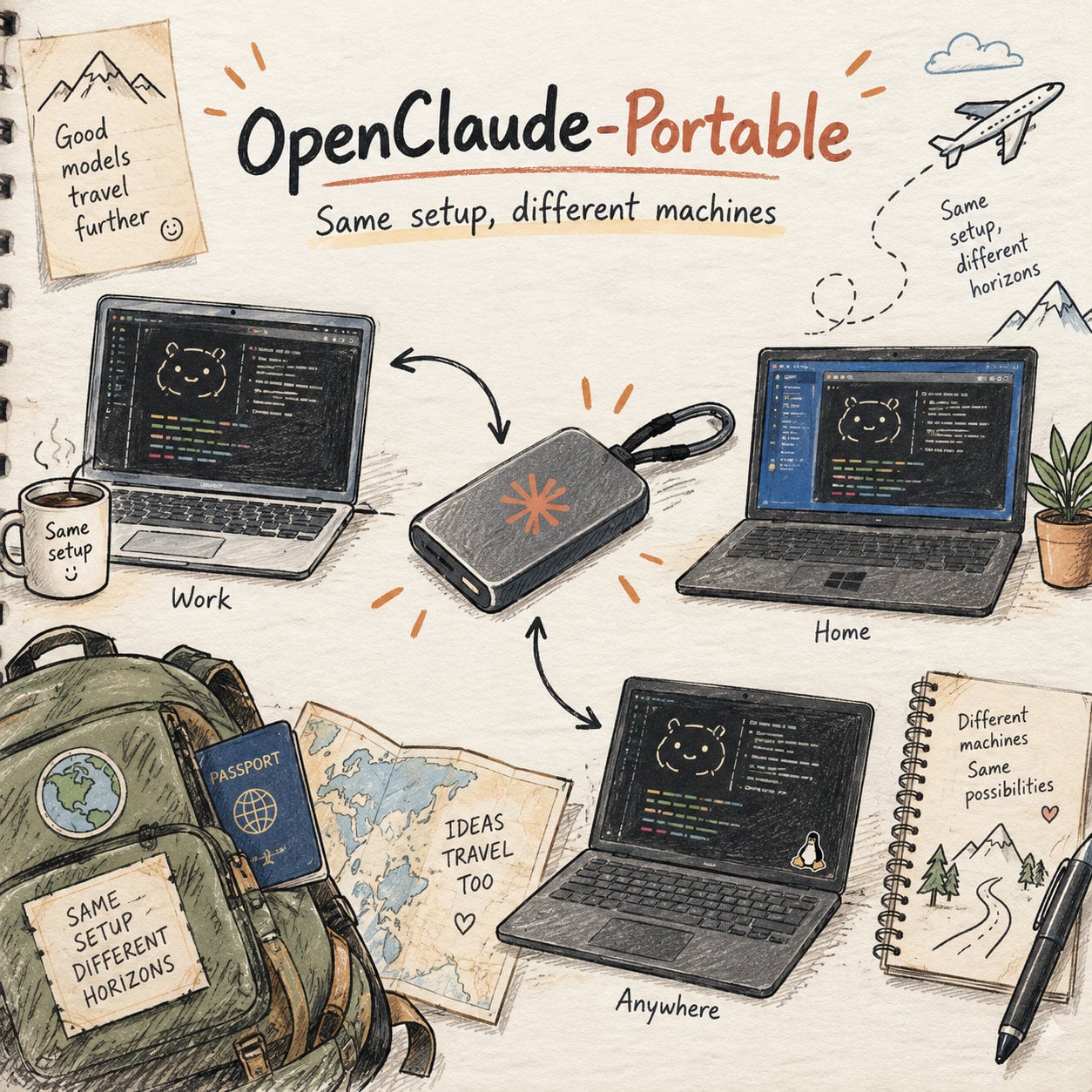
💻 I am not especially interested in the novelty of "Claude on a USB drive."
What I do care about is avoiding repetitive setup.
That is why [OpenClaude-Portable](https://github.com/techjarves/OpenClaude-Portable) caught my attention.
It packages an AI coding agent into a self-contained folder and keeps the runtime, settings and persistent data with it.
One portable setup, multiple model providers
The project currently supports 9 provider options, including Claude, OpenAI, Gemini, DeepSeek, OpenRouter, NVIDIA NIM, Ollama, LM Studio and custom OpenAI-compatible APIs.
That is useful because I do not have to choose between "portable" and "flexible."
I can use cloud providers when I have connectivity, or use a local Ollama model when I want the setup to keep working offline.
The first setup needs internet, but after that Ollama mode can run without it.
The state travels with the project
This is the feature I care about most.
Provider configuration, API keys, logs, session history and agent memory are redirected into the project's own `data` folder.
The repository describes this as a zero-footprint setup because it avoids writing configuration into the host system.
That means the environment can move between machines with much less cleanup or reconstruction. 💾
Windows, Linux and macOS share the same persistent data structure.
For someone who uses more than one computer, that is much more practical than it sounds.
It has a sensible permission split
The launcher has two modes.
Normal Mode asks before the agent writes files or runs shell commands.
Limitless Mode removes those approval prompts for a more autonomous workflow.
I like that the distinction is visible and intentional.
My default would be Normal Mode, but having an autonomous option is useful for controlled environments where I already know what I want the agent to do.
A local model does not have to feel unbearably slow
Running a coding agent against a small local model is often disappointing because the agent framework sends a very large system prompt.
OpenClaude-Portable adds a proxy that trims that prompt before it reaches Ollama.
The repository reports reducing roughly 10,000 tokens to about 300 on that path, and typical first-token latency on CPU-only hardware improving from 60-120 seconds to around 5-20 seconds.
Those are project-reported numbers rather than independent benchmarks, but the direction is what interests me.
It is a design that takes the weakest part of local coding agents and tries to solve it directly.
Session resume is another detail I appreciate
Agent sessions and memory live inside the project folder, and the Windows setup includes a resume command for interrupted sessions.
There is also a browser dashboard if you prefer a ChatGPT-style interface over the terminal.
Those are small features, but they make the portable setup feel less disposable.
Storage requirements are reasonable
The base runtime and engine need about 150 MB.
Local Ollama models add roughly 800 MB to 8 GB depending on the model.
The README also warns that first-time installation can be slow on old USB media. I would use USB 3.x or, better, a small external SSD if I planned to work from the drive regularly.
Where I would use it
For me, the strongest use cases are:
- travel
- a backup development environment
- temporary machines
- offline coding with Ollama
- testing several providers from one configuration
- recovery when my main workstation is unavailable
The interesting part is not carrying an AI agent in my pocket.
It is carrying the configuration and state that make the agent useful.